Are Humans Framed?
Instantiation Of This Quest
I was grappling with the notion frame while proposing the next chapter of my thesis. I believed that current deep learning models are confined within rigid computational frames, in the sense that the mutable factors — most often limited to the values of the weights — are extremely constrained. The computational structure underlying both learning and inference is largely immutable. What I am proposing, broadly speaking, is to enlarge this frame, or to make more components of the frame mutable.
In one of our research meetings, my professor asked: are humans framed?
My answer given at the time was yes — humans are framed. But humans are confined within vastly larger frames than those that constrain current deep learning models. What I value, therefore, it not the idea of giving birth to “beings” that are outright less confined, but the incubation of the ability to recognize the limit of one's current frame and to enlarge it.
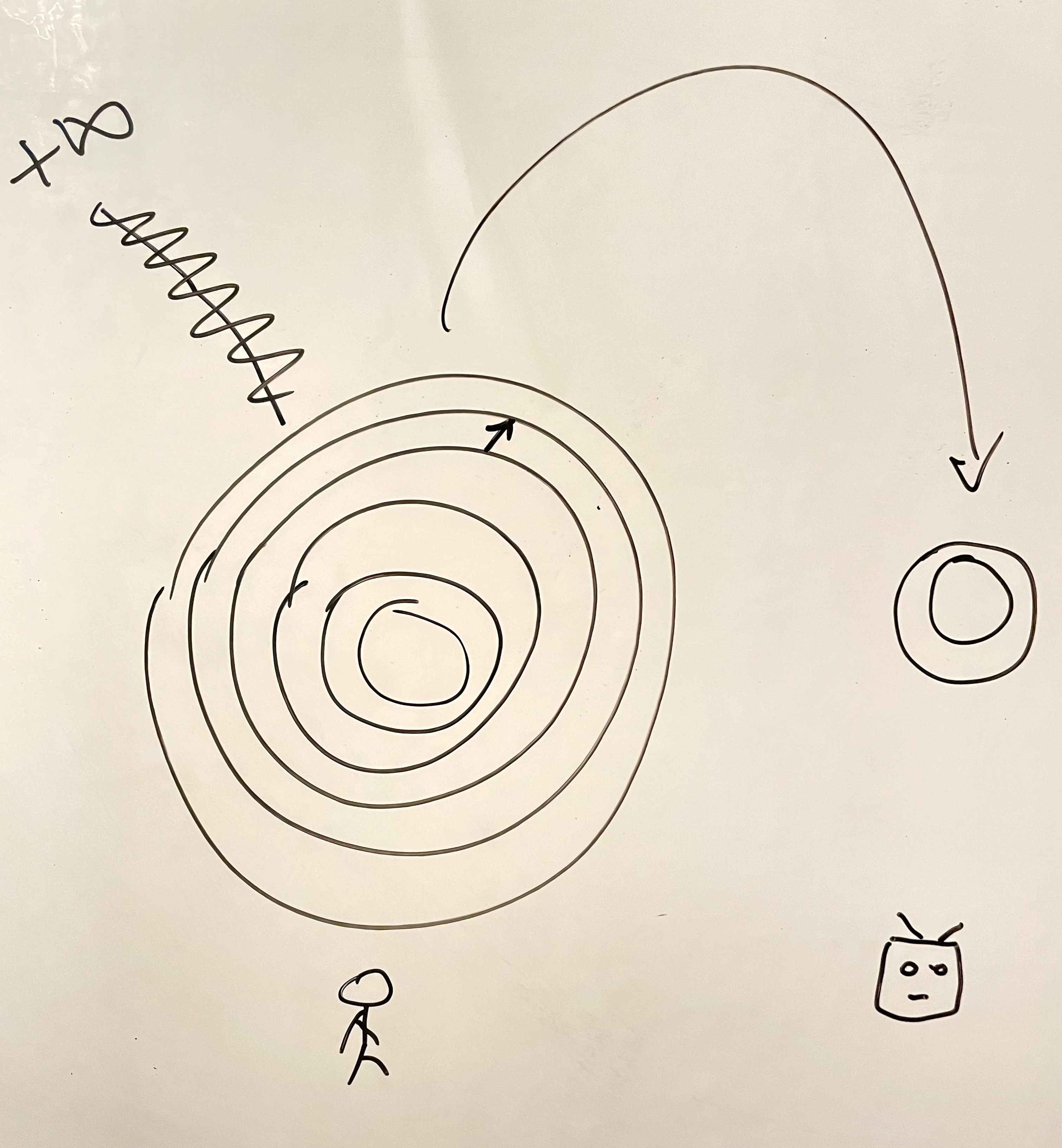
Figure: My funny drawing depicting both humans and machines as framed, though to differing degrees. The arrow from humans to machines suggest that the potential, quest, or strategy for breaking frames naturally flows from relatively less-framed beings (humans) to more-framed ones (machines). This “outward” energy is contagious.
In research, I naturally advocate techniques that "break free" from the frame a learning system was previous constrained within. Yet this "breaking free" is never a once-and-for-all act. Escaping a given frame always lands you in a larger one — now the game repeats, just in a new context.
Setting research questions aside, I cannot help but thinking about the human analogue of frame-shifting. I tend to see frame-shifting as a kind of mental-shift — something you experience in an aha-moment, when a new interpretation suddenly clicks, or when you begin to see something through a fresh lens. Prior to such a shift, one's thinking is largely conditioned by the frame. This conditioning remains invisible until the moment when one is exposed to a fresh perspective they've never considered before. The frame-shifting experience often feels like an expansion: the world gets larger, richer, or newly articulated.
People usually emphasize "thinking outside-the-box" as a way to break free from old frames. I don't wish to simply restate the importance of that idea.
Instead, I want to ask: Is this capacity for "thinking outside-the-box" always better in greater amounts? What does the extreme case of "thinking outside-the-box" look like? What are the less pleasant consequences of pushing it to the limit? We might want to harmonize the drive and fuel for breaking frames with their countervailing forces.
The Shadow Of Questioning
On the bright side, questioning reflects curiosity. Its shadow is disbelief. This disbelief is a refusal to accept that the “box” — whatever it contains, however encompassing it appears — is ever all-inclusive. It must be incomplete, it must be still lacking. But what happens when this shadow grows much powerful? Two kinds of unpleasant consequences may emerge. One is cognitive dissonance, and the other is nihilism.
Cognitive dissonance arises when large amounts of incongruent information are absorbed, while the mind has not yet formed a coherent understanding to hold them together. The mind has a natural inclination to detect and reconcile conflicts, by constructing narratives, or by generating auxiliary hypotheses. It is always trying to "patch the holes". But when there are too many holes, or when the holes appear faster than they can be patched, the effort to restore coherence itself becomes overwhelming and disconcerting. That state of overload is cognitive dissonance.
Nihilism arises when one steps outside the box only to encounter a vast wilderness — more exposed, more barren, with less to hold on to and less to rest upon. Under right conditions, including luck, security, and preparedness, this wilderness can feel capacious and liberating, inviting wanderers and wayfinders to venture further. When appropriate conditions are absent, however, the same wilderness becomes scary and discouraging. And once one jumps outside the box, it's hard to crawl back in; it's hard to unknow what you know; it's hard to unsee what you see. Confronted with the wilderness in terror, one faces the unnerving question of whether anything is ever real. Or whether nothing is real. This encounter with nothingness, when met by a terrified and contracting mind, is nihilism.
Existential Health
Many things in life are games. One could even argue that everything in life is a game. But there are distinctions. From an individual's point of view, there are at least three types of games:
1. games we know are games but happily choose to play
2. games we know are games, and therefore have no interest in playing
3. games we happily play, unaware of that they are games at all
One's existential health depends on how their lived world is partitioned among these three categories.
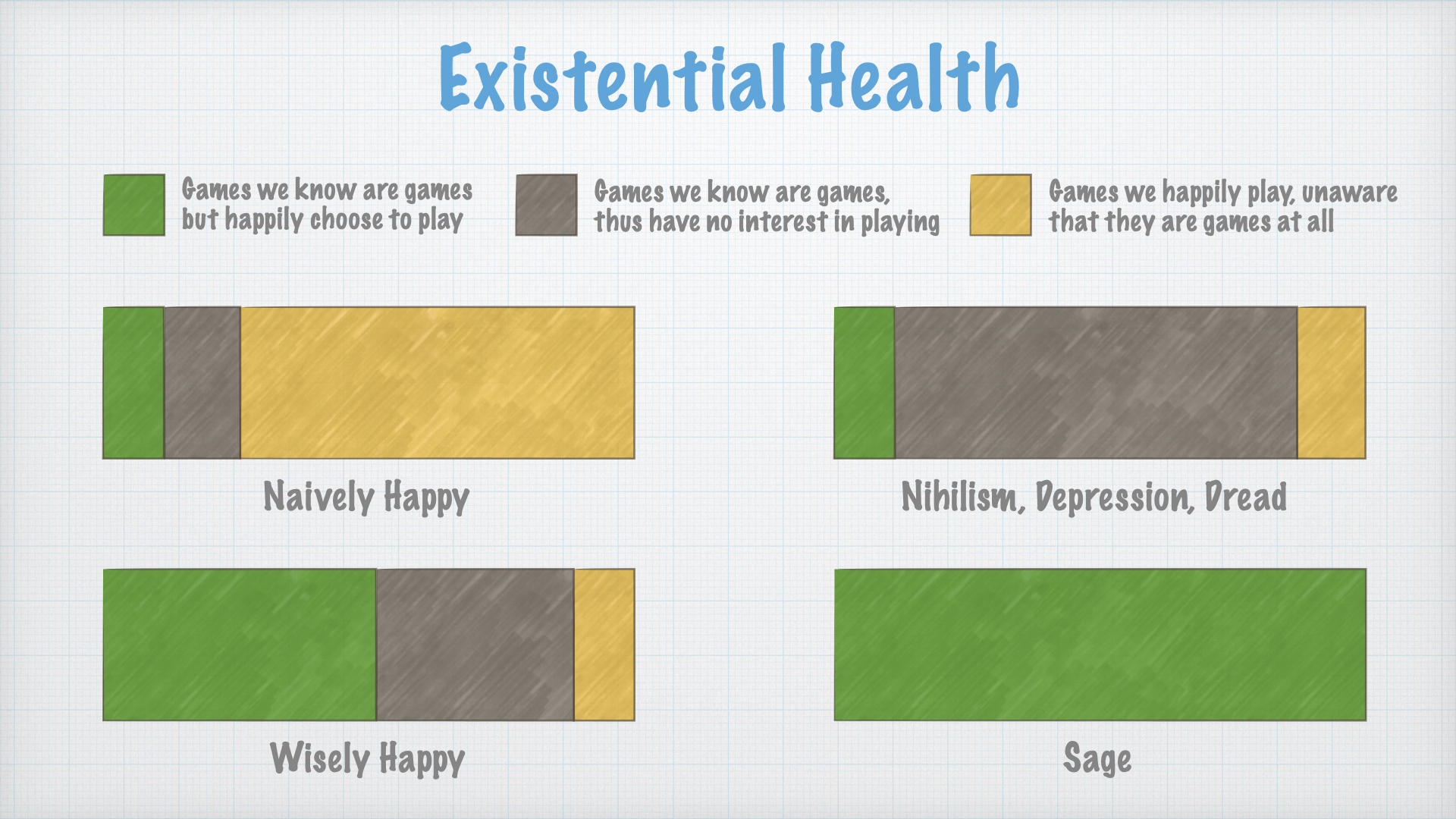
The shadow of questioning is felt most acutely when one realizes that something once played unconsciously was just a game —— when portions of one's life shift from 'yellow' to 'grey'. Upon this realization, I don't think the right response is to holding back curiosity or to blame oneself for excessive questioning. Nor do I want to end this story with the familiar moral that "balance is the key".
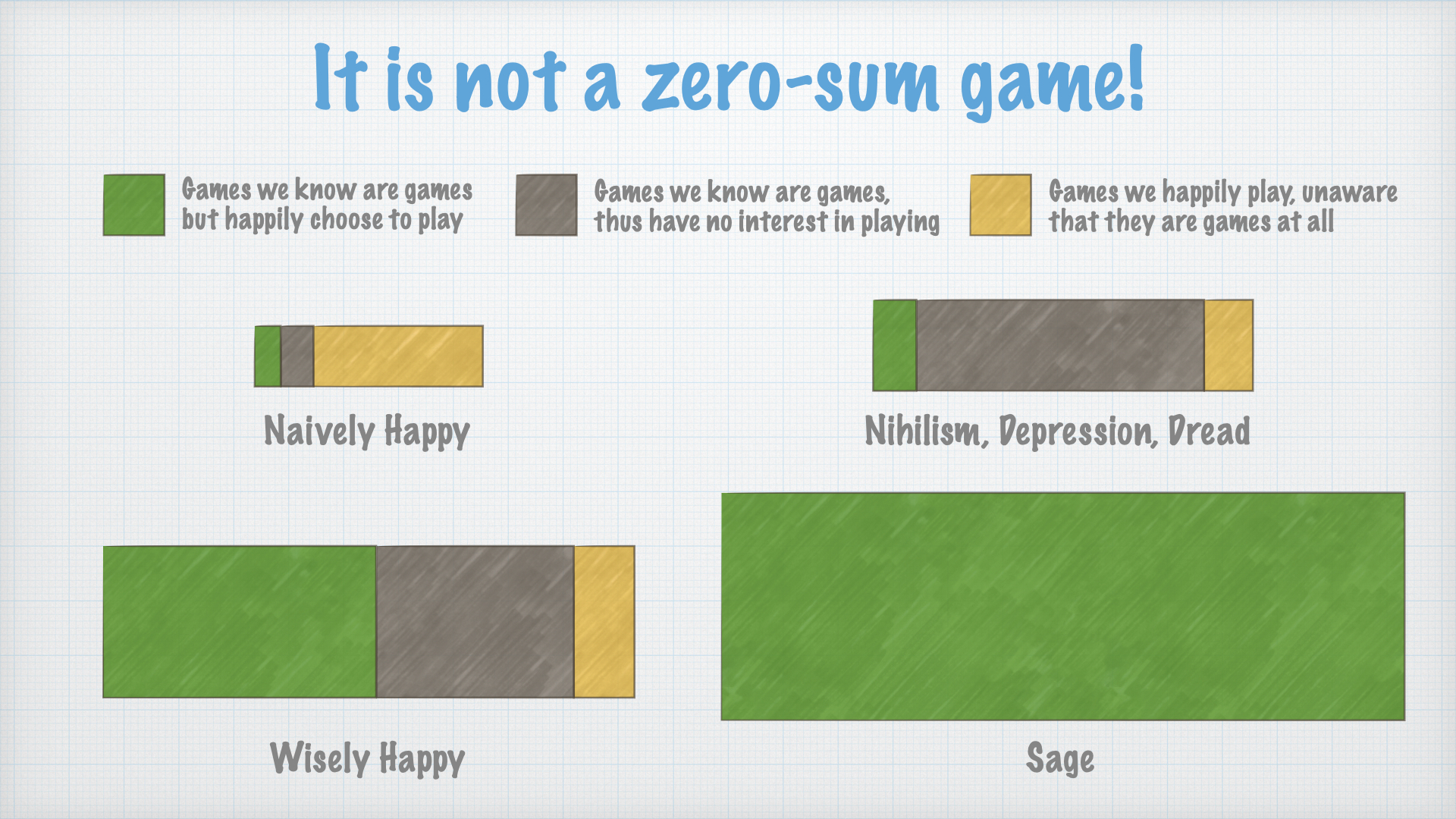
Note that the figure above illustrates only the relative proportions of games across four different stages. What it does not depict is the absolute sizes. When you see much of your existing life turn grey, you may feel an impulse to reclaim the 'yellow' or the 'green'. But the solution does not lie in converting what has become an uninteresting game back into an interesting one, let alone into an unconscious one. That move feels backwards.
The real move lies in discovering new possibilities. The goal is to grow the relative proportion of the green region while shrinking the relative proportion of the grey. To do so, you don't have to convert grey into something else. After all, it may seem quite unlikely! Crucially, one's "world" — the total area — is constantly expanding. As such, this is not about equal exchange. It's not a zero-sum game. Below, I offer a more faithful visualization.
The Ambivalent Progress
The transition from "naively happy" to entering the uncanny second state of "nihilism, depression, dread" shook many things I once held onto. At first, it felt like a zero-sum trade: things that used to supply joy were no longer desired. More 'yellow' turned into 'grey'. The 'green' was vanishing. There was loss, no gain. I got panicked, restless, and cynical. I began to wonder whether something had gone awfully wrong.
I examined the 'grey' over and over again, trying to recover elements that might be moved back into the 'green'. But this effort largely failed. Eventually, I found myself in a disorienting pool. I had assumed that seeing through unconscious games would count as progress, yet instead it rendered me depressed and nihilistic. It stripped away a liveliness that had once been abundant before the act of 'seeing through'. Such progress sounded deeply ironic! It resembled degeneration: seeing more seemed to mean living less, enjoying less.
How to retain a healthy distribution in how one subjectively experiences these games? There appears to be no alternative but expand one's territory. You might adopt the hopeless belief that, no matter how much you expand, you will never be able to invite enough 'green' into your life to counterbalance the vast 'grey' already present. Yet that belief remains untested. Once you make it through even a single episode of expansion, you may be startled by how boundless the potential for expansion actually is.
The Lingering Sorrow
Expanding my territory enabled the transition from "nihilism, depression, dread" to "wisely happy". After this second transition — one that felt like a return — was everything finally settled? No. What remained was a mixed feeling.
On the one hand, I was immensely grateful for what had happened to me: for not having completely paralyzed by the enormous 'grey'; for the fact that there was still so much out there for me to venture into; for the boundless territory waiting to be illuminated.
On the other hand, I carried a kind of post-traumatic fear. The intermediate stage between "naively happy" and "wisely happy" was a detour that exacted a real toll. Even with the relief of having survived, I was haunted by lingering "what-ifs". What if I hadn't made it through? It felt so close, so "against all odds"! What if this long haul had exhausted all my luck? What if I wouldn't be as lucky next time?
I began to question whether the timing at which I saw through my previous games had been imprudent. If only I had slowed down a little; if only I had been more cautious and less adventurous; if only I had been patient enough to let knowledge accumulate before abandoning my former beliefs — perhaps I could have skirted around the gloomy stage and made a direct transition into being "wisely happy".
I distilled a more ideal picture from my seemingly convoluted trajectory: When one has accumulated sufficient knowledge, experience, and insights to draw upon, realizing that something has always been a game should feel like an advance rather than a regression. But that precondition requires engagement. And engagement is more easily sustained when you play in the yellow regime than in the grey (wherein you'd play through sheer willpower under disbelief). Comparing the idealized picture with my actual experience, I felt sorrow over the bad "timing". I questioned the legitimacy of having to endure the misalignment between what I saw and how I lived, of sitting in the 'grey' before more 'green' could arise. I even had an impulse to blame the timing, treating it as the culprit behind my suffering. I thought that, had the timing been right — had engagement been sufficient before the onset of transition — I might have been spared the disconcerting tug-of-war of covert progress disguised as destruction.
And so here I am, stumbling through some arduous process, licking my wounds while reflecting on which parts of the process feel like mishaps. Could the second stage have been circumvented? Why am I even asking this? Was I caught in an endless loop of dissatisfaction? Popular wisdom would warn me against being too perfectionistic, against holding standards that are too high, against wanting too much. But I knew this was not the case. Such advice would only breed more self-doubt, hesitation, and indecisiveness.
A Multitude of Processes
I offer myself a healthier response: there isn't just one process. I am simultaneously living through a multitude of processes.
In some processes, I am a survivor who has endured a great deal of suffering. For example, the process by which I figured out these stages of existential health.
In some processes, I am the cynical one, stranded in the middle and shunning away from what feels meaningless. For example, I find much of the financial industry meaningless, so I never entered it. But I can imagine that profound players in that game may acquire genuine insights into humanity. I also hold fairly nihilistic views toward romantic relationships, religion, and international affairs. Still, I can imagine that these domains, too, may contain portals to genuine insight — portals that become visible only with substantial maturity.
In some processes, I am the lucky one who happened to strike "just the right timing", where 'yellow' transformed into 'green' without passing through 'grey'. Had I realized early on that language does not "exist", that everything is constructed, that even nouns referring to physical entities are constructions, I might never have entered the field of NLP at all. I could have dismissed it as a game played in utter illusion. Fortunately I didn't. By the time I recognized language as a game rooted in imagination, I had already come to see it as a beautiful game worthy of orienting my efforts toward. Generalizing from NLP to science as a whole, I am similarly fortunate to have a non-self-destructive mindset. I see science itself as a game, and I happily play it. While there's an element of uncovering the truth, I'm not super obsessed with the truth, because there's no absolute truth. Everything is relative, subjective, and contingent on interpretation. Despite the dissolution of glowing purposes and alluring destinations, I still find science fascinating and want to devote substantial energy into scientific activities.
In some processes, I am the ignorant one who hasn't initiated any transition at all. I cannot raise an example here because my ignorance, by definition, conceals them.
Transition, expansions, and the breaking of mental frames happen across multiple scales, contexts, and scopes. The wisdom gained in one process can be used to inform the practice in moving through another.
Finding oneself distributed across diverse stages, in a multitude of processes, is a kind of blessing. It mitigates the nihilism and doubt that can feel tremendously destructive when one zooms in on a single process alone. During a phase that feels particularly grey, it becomes important to recognize that there are always a few other processes unfolding — some of which still contain a pleasant mix of naivety, dread, and wisdom.
Tend To The Shadow
While curiosity is celebrated, the harmonizing factor that prevents curiosity from tipping into a landslide of disbelief is often underappreciated.
To achieve this harmony, at minimum, one must to believe in something, regardless of whether it is a naive belief, or an intentional one.
Being able to question is a blessing. Being able to believe is also a blessing. For me, the latter deserves more appreciation.
If I were to constantly question what I believe without pause, I would fall into eternal indecisiveness. I would plunge into the vast 'grey' without having 'yellow' or 'green' as relay points to catch my breath. I know what it feels like to walk on the verge of nihilism. The lingering sorrow serves as a reminder not to let that landslide of disbelief run unchecked.
I am not particularly worried about the part of me that wants to question. She's self-reproducing, self-sustaining, and self-entertaining; she's perfectly content exercising her disruptive power against "limiting beliefs" and enjoying herself.
By contrast, I should tend more carefully to the part of me that still believes, or that has returned from disbelief to embrace faith.