Onshore
Part I: Borderline
My life was just reinitialized.
Last Saturday (day 1), I turned to ChatGPT for emergency therapy. I rambled a long passage of how much I felt like a stranger and how aware I was of the cost of this transition. It asked me: What would make the adaptation feel worth the cost, even if you didn't end up staying in the Netherlands?
What immediately came to me was “expansion”. I care less about the eventual outcome of adaptation, or the particularly ways a new place might shape me. Becoming someone I barely recognize doesn't frighten me as much; I don't think my core is easily rewritten. What I imagine about expansion, then, looks like becoming something larger, developing new parts, and integrating them into my existing core.
Last Sunday (day 2) I was full of emotions. There were opposing forces spilling into one another. I needed time set aside to untangle them, so I decided, on impulse, to find a cafe outside the tourist areas and journal. I ended up spending 5 hours writing, split between Kafenion and Cloud Cafe. I was processing loss, fear, and disorientation. I was mourning a parallel life in which I hadn't said yes to a change this big. I was contemplating whether this was what Kierkegaard called “the dizziness of freedom”.
I spent most of the first week swimming in unease. I wouldn't call it disappointment, because disappointment presupposes an expectation, but it would be presumptuous even to have any expectation. It was a more diffuse sense of alienness.
It's tough because I'm holding a lot of differences. I no longer know how to infer their implications. At the moment I just have to somehow “contain” them. Never having your beliefs questioned is a sweet thing that I seldom have the privilege to enjoy. I see outsiders antagonize or romanticize insiders. And I'm neither an outsider nor an insider. I am a curious and messy mixture. I traverse the borderlines. And I have too much awareness to dismiss information as irrelevant noise.
Tonight, as I write this, day 8 is already drawing to a close. Many of my the judgments I formed so quickly during the first week have softened or shifted. I'm beginning to see concrete things to look forward to, even as I continue to stumble through the initial hurdles as a clumsy newcomer.
Part II: Unmoored
I thought I could settle in within a week. I keep using my internship experience in the SF Bay Area as a reference point. Moving there from Pittsburgh had taken only 1 day.
Flying from the east coast to the west coast gave 3 extra hour. With the rental contract signed in advance, the apartment was ready for me to move into upon arrival. I would preorder a mattress topper, a simple table, and two folding chairs from Amazon, timing their delivery for the day I arrived. That afternoon, I could go to Xfinity to arrange wifi service, then head to Target — which stayed open until 10pm — for a basic bedding set and a comforter.
I did this in two summers in a row. The first summer, I booked two nights at a hotel as a buffer. Once I realized that everything could be ordered to deliver in advance, including Target items, I moved straight in the second summer — smooth and seamless, provided by flight wasn't delayed. I remember sitting on the floor, unpacking all the essentials: a water boiler, kitchenware, dishes, haircare products, a shower curtain, pillows, lamps … basically everything!
I admit it: those easy moves from Pittsburgh to California spoiled me and set my expectations too high.
I knew I had no real basis for knowing what to expect. Still, I kept thinking: if everything went well, perhaps the most efficient version of settling in would only take 4 days.
Before leaving for Amsterdam, I pictured a best-case scenario in which I navigate an extraordinarily efficient immigration system and equally efficient public services, amazed at how much I could accomplish each day while building a life from scratch. I imagined posting something on social media like the following about a week after arriving:
Day 1: Picked up my ID card at the immigration office; got a SIM card; opened a bank account.
Day 2: Signed a lease; got the keys to my new apartment.
Day 3: Set up wifi; went to the supermarket; ordered lots and lots of things from Amazon.
Day 4: Assembling furnitures; went to the university; got my office key and laptop offered by the institute …
How funny! That imaginary brag now feels like a dreamy mirage.
The actual process has moved at a much slower pace, with surprises that keep catching me unprepared.
First surprise: things are less parallelizable than I assumed.
I arrived on Friday, with an appointment at the immigration office scheduled for Monday. It didn't take long to realize that I needed a Dutch residence card to get everything else started, which meant virtually nothing could be done on Saturday or Sunday. “Sure, sure,” I told myself. “Let me spend the first weekend purely as a tourist.”
Second surprise: signing a lease has to come last, rather than first.
Securing a rental agreement comes with so many prerequisites that tie into a deadlock. For example, I need an address to receive bank card, and physical letters containing important activation codes; yet the tenant check requires scans of that bank card and those services already activated before I can get any closer to signing a lease. For another example, I need to upload an employer statement, but requesting one requires access to a UvA internal system, which I won't have until my first day at work.
So, in the middle of getting documents, numbers, and subscriptions ready, I've been asking here and there whether there's a way around these deadlocks and whether a step might be skipped for now with the missing information supplied later. A week passed quickly. Oops, Friday afternoon again! Nobody works on weekends, so I can't expect anything to move for the next 60 hours.
Third surprise: apartments are rented out without flooring.
Having dealt with unfurnished apartments in the US, I'm familiar with the inconvenience of buying and selling furniture. Buying and installing a floor, though, is something new on an entirely different level. When I complained to a friend, she told me she knew someone who had moved to Germany, where they have removable kitchens. I suppose I ought to feel relieved that, at least, this doesn't extend to removable roofs …
Part III: Minimally portable
After extending my hotel stay twice — adding four nights to the four I'd originally booked — I began looking for other temporary accommodations. Alex, an administrative staff member who helped with my onboarding, suggested her favorite seaside town, Zandvoort, where I might find a more reasonably priced Airbnb.
Today is Saturday. I moved from Amsterdam to Zandvoort, and it was a funny day.
In the morning, I went to the university, hoping to leave two suitcases in my office for a few days so I wouldn't have to drag them around, only to discover that the building is locked on weekends. Maybe I'd been wrong to assume that Lab42 was just like any other academic building. Luckily, a security guy approached me and let me in. I then I spent an hour at the gym, completely satisfied that, although I didn't yet have a designated place to sleep, I had a designated place to pass the time while working out.
On the way to Zandvoort, I boarded the wrong train. Thankfully, it cost me no detour because I immediately jumped off at the next station, before its route diverged from the one I needed.
I arrived at Zandvoort station 55 minutes before my Airbnb's check-in time, which meant I could really take my time dragging a large suitcase along the brick roads. As a newcomer in a foreign land, I find an occasion to feel stupid practically every minute. My suitcase made so much noise that I assumed I was annoying every passerby. I stopped at a Thai restaurant for takeaway, then at a grocery store for food and water, where I ended up buying sparkling water — an amusing addition on top of my ongoing sense of stupidity. The bottles on one shelf were labeled “spa water”, which I cleverly avoided. The next shelf said “mineraalwater”, which looked so convincingly like still water 🤪.
But I am making progress: I no longer obsess over tearing the bottle cap off. The bottles here are designed differently and the cap is meant to stay attached.
So I left the one-liter bottle of sparkling water standing on the windowsill, hoping it would gradually become less sparkling.
In three seconds, blue skies gave way to heavy rain. This Airbnb feels unbelievably cozy. I like the lampshade made of woven bamboo strips. The window is disproportionately large, making the divide between me and the outdoors feel thinner.
Wow, holy moly — why is there a double rainbow every time it rains here? 🤩
It indeed takes a major change to reveal which contributors of coziness I carry within me and which depend on my circumstances. I would consider life generous if it offers me interesting people and interesting places to read. Reading, in this broad sense, is cozy.
Solitude and the ability to enjoy writing are portable, too. And apparently, my magical skill at booking unexpectedly good Airbnbs has followed me all the way here 😼.
It's been a long day. It's been a long week. It's been a long year. The past ten months have been a cascade of a transformation and revelation.
Only in losing it have I begun to see what used to fade into a background of comfort. On Wednesday I shed tears in front of my therapist because there was too much grief. I am excited about the adventures ahead, and I appreciate how many opportunities have opened up. But none of that cancels out the grief of having to discard so much of what I'd worked to acquire, simply to compress my life into a minimally portable form.
On the one hand, I'm frustrated by how much it takes to rebuild a life, and by how much I once had, only to throw away with a willful click on the button “I accept the offer.”
On the other hand, I'm discovering how little it actually takes to stay alive — access to a bed, a shower, food, water. Add access to gym, and I don't have to worry about back pain. I can run on “battery life” for 2 weeks at most before my chronically fatigued muscles begin to complain. Add a way to get around, I don't have to worry about finding things to do during the day.
I still don't have an apartment ready to move into. A few nights ago, while researching hostels, I realized that all I needed was a bed, which could just as well take the form of an air mattress or a yoga mat. I even joked about living in my office, though it turns out that fire safety rules prohibit it. Thankfully, I found an Airbnb and never had to resort to that. In the meantime, I've gained access to my office and joined a gym.
With each rainfall, more things will fall into place.
Part IV: Water with moods
I know some people might envy me: those who want a change from their current life but don't know where to start. I'm dealing with the opposite. I hadn't asked for a change; it presented itself. Before I understood the consequence, I had already made a decision. Before I had a clearer picture of what I'd signed up for, I was already rebuilding my life.
At the lab dinner on Thursday, Katia, my new supervisor, acknowledged that I was doing blind gambling. I love her for putting it that way.
During my interview, she casually asked why I'd applied to a European institute, whether I'd been here before, and why I wanted to move abroad. I told her it was the only European institute I'd applied to, and that I'd never been to Europe. I had no idea. I had simply applied. I thought she might count such a thoughtless answer as a negative evidence. But she offered me the position, which said something about her, too.
I don't know what her decision process looked like. Mine ran backwards: I made the decision, then began investigating what I'd committed to.
What requires the least adaptation, surprising, is work. While so many parts of my life requires deconstruct-and-recreate, my brain delightfully supports plug-and-play.
My labmates are curious about how I'm finding the new city, country, and continent. I keep saying that I can't arrive at any conclusions yet. When it comes to knowing how to live here, it's as though they're running RLHF experiments while I'm still struggling with Python programming 🤪.
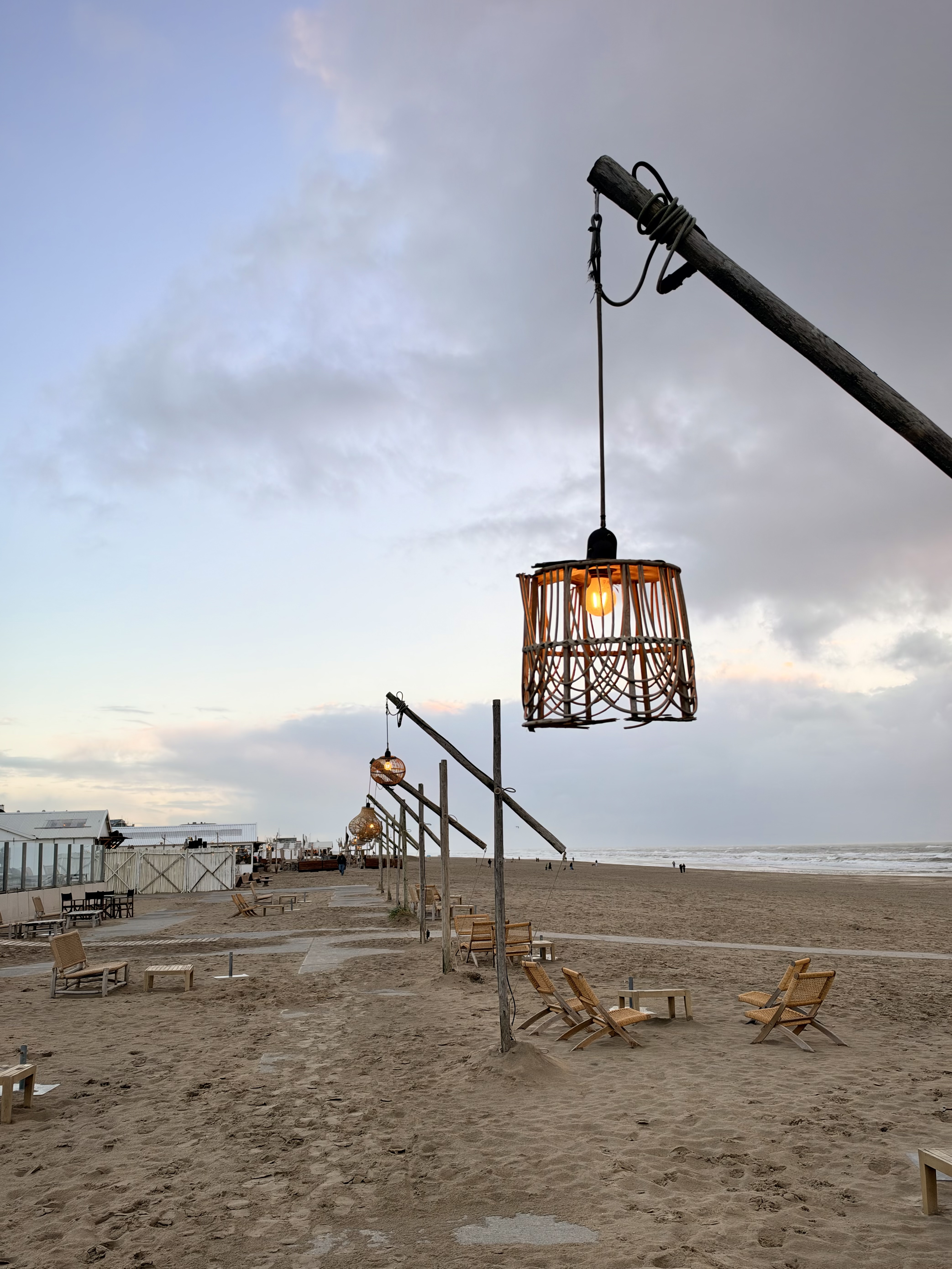
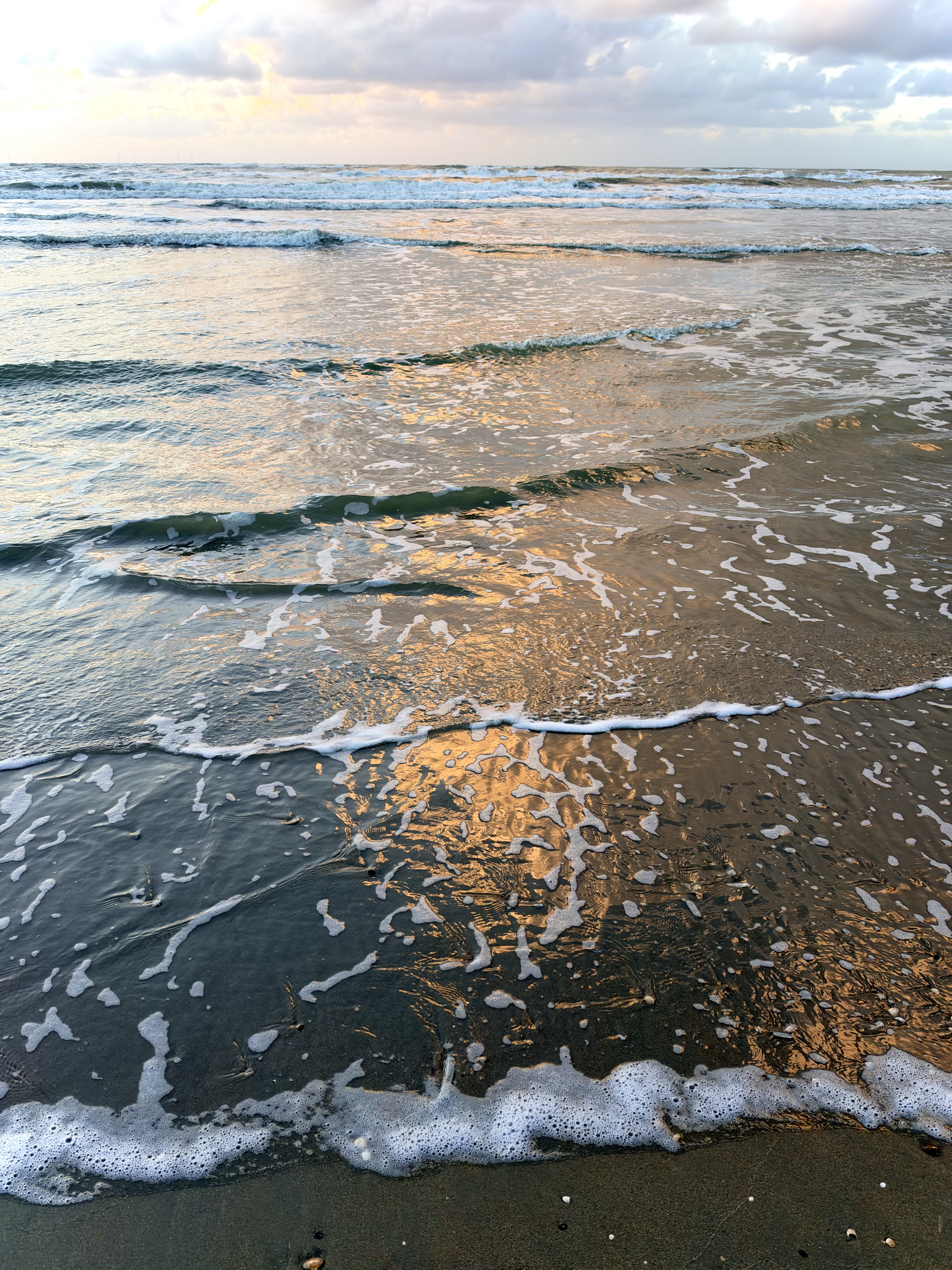
This evening, I walked along the beach for the last thirty minutes before sunset. The whole sky looked creamy. Lanterns with woven shades hung from a string along the footpath, swaying to the rhythm of the wind.
Across the beach, wooden restaurant buildings and beach chairs blended into the landscape. It reminded me of Burning Man in the Nevada desert: vast, boundless, and primeval, as though human settlements were permitted only a temporary presence here.
I feel far more connected to forests and mountains than to the sea. I'm not a beach person, partly because I didn't grow up in a seaside city. Today, however, I felt as if every beach I visited before was a “beach resort”, rather than a beach.
I follow several composers on Spotify whose music shares a minimalist, emotional, introspective quality. Much of it sounds like water. They also happen to be European: Ólafur Arnalds, Luke Faulkner, and James Quinn. Seeing the sea this evening, I thought: no wonder they write music that sounds like water. And not just water, but water with moods and sensations.
Part V: Dizziness
Much of the reserve, alienness, and distance I feel can be traced to a question that keeps returning unresolved: do the people who live here still have attention to spare for a stranger? I understand how the unavailability of attention might follow naturally from being settled in a life that already has its people, its purpose, and supply in every sense. Yet the apparent comfort of locals, the sense that they need nothing more, leaves me feeling peripheral. What I keep wondering is: does their comfort have room to expand?
I am not judging either side of this situation because I've been on both sides. I've lived as a local — a position granted to me in China and earned through tremendous effort in Pittsburgh. I know that an ordinary response from someone living as a local can make a newcomer feel rejected, without either person being at fault. This morning, for example, I tried to enter my office building and discovered that it was closed for the weekend. A security guard yelled at me because I didn’t know how to ring the bell so he could open the door remotely. He was kind enough to let me in, yet I felt stupid and embarrassed. Walking back to the hotel, I wished I could be invisible.
During the orientation weeks in 2025 and 2026, I watched new students settling into an unfamiliar place. Their efforts to fit in were so visible. Watching them reminded me how much of my own familiarity, safety, and warmth had been earned the hard way.
Perhaps what upsets me is how quickly, and seemingly imprudently, I gave those things up. Now it's my turn to worry about fitting in again.
I used to reflect on what can be a better gesture when listening to someone describe their suffering I had the privilege of not being engulfed by. I didn't want that person to feel dismissed, or to sound entitled as though I were minimizing their pain. I would say: “I may not taste your pain as immersively as you do, but that doesn't mean I live happily ever after. Suffering is a universal human condition. Being spared one kind of pain can make you appear, to others, to have been spared suffering altogether. Yet beyond that pain, another door opens, with other kinds of suffering waiting behind it.” Someone struggling for physical safety or health, for example, might find it difficult to imagine that, once those needs are met, psychological insecurity and unwellness can be equally painful and real.
Now I've changed sides. I'm the one voicing struggles that others — people already at home in Europe, for instance — may have the privilege of not being immersed in. What might they say to someone without that privilege, following the same logic I reached for when I stood on the other side? I think I would be glad to hear them acknowledge their privilege while explaining how it also makes other difficulties harder to ignore. As one pain recedes, another becomes visible. That doesn't cancel out their advantage, nor does it make my pain any less warranted.
I have had belonging bundled with my birthplace. I have swum in its absence. I have also had belonging earned through years of effort. Now I am reinitialized. When memories of the past play back like a videotape, I feel the weight of loss, even though coming here was my choice.
I keep noticing a stark contrast between how I experience this place from within and how others — presumably locals — seem to experience it. I try to imagine their interior lives beyond the advantage that is so visible to me. The extraordinary ease I see is filtered through a lens heavily biased by my own lack of familiarity, safety, and warmth. There must be more to their lives than the ease I can currently see, and cannot yet see beyond.
One would think more freedom means more peace. Of course it doesn't.
It couldn't.
There is a profound qualitative difference between more freedom and unlimited freedom. Within the limits inherent to being human, the gains from greater freedom diminish, because it opens up more room for the human boundedness and smallness to be more tangibly felt. As this room grows beyond a certain point, freedom begins to produce the very condition we imagine we need more freedom to escape.